
 ES
ES NL
NL FR
FR PL
PL SV
SV DE
DE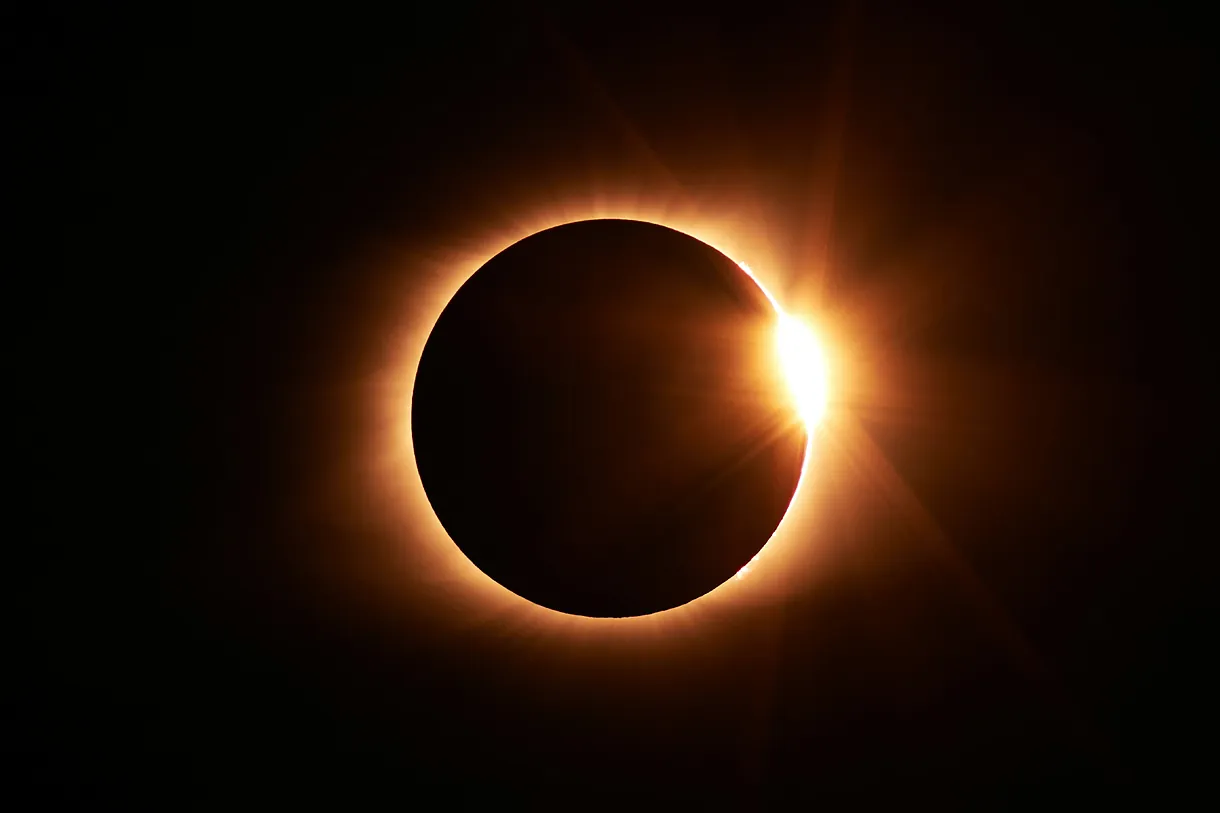
On August 12, 2026, Estepona and Marbella watched roughly 94% of the Sun disappear behind the Moon and still couldn’t get the sky to go dark. That was the honest trade-off of a deep partial eclipse from south of the path of totality: genuinely rare, but not the real thing.
Less than a year later, the real thing arrives here. On Monday, August 2, 2027, a total solar eclipse crosses the Strait of Gibraltar and the entire Costa del Sol sits inside the path this time, not south of it. The sky will go fully dark in the middle of the morning, the solar corona will be visible with the naked eye, and it will last longer here than almost anywhere else on the route.
Why this one is different
In 2026, Estepona and Marbella were outside the band, watching a partial eclipse from the sidelines. In 2027, the towns are inside it. The path of totality runs from the Strait of Gibraltar across Ceuta, Melilla, almost all of Cádiz province, part of Málaga province, and into southern Granada and Almería. Estepona and Marbella fall squarely within it.
The viewing conditions flip too. In 2026, the Sun sat just 6 degrees above the horizon at peak, low enough that a building five storeys tall could block the entire event. In 2027, the eclipse happens at mid-morning with the Sun 39 degrees up, high enough to see clearly from almost anywhere with open sky, no coastal cliff or west-facing terrace required.
How long totality lasts here
Duration varies slightly by exact location, but this stretch of coast does unusually well:
- Estepona: maximum eclipse around 10:48am local time, with totality lasting approximately 3 minutes 40 seconds
- Marbella: totality just over 3 minutes 17 seconds
- Málaga city: around 1 minute 48 seconds, noticeably shorter since it sits nearer the edge of the band
For comparison, Tarifa, Ceuta and Melilla, closer to the centre line of the path, get over four and a half minutes. But Estepona’s nearly 3 minutes 40 seconds is still a long totality by eclipse standards, most total eclipses anywhere in the world last under three minutes.
What actually happens during totality
For those minutes, and only those minutes, it’s safe to look directly at the Sun without glasses. The Moon fully blocks the disc, the sky darkens like dusk, the temperature drops, and the solar corona, the faint outer atmosphere of the Sun normally invisible in daylight, becomes visible as a pale ring. Birds go quiet. Streetlights on sensors can switch on. It’s a completely different experience from the partial eclipse the coast saw in 2026.
Outside those few minutes, before and after totality, the same rules as any partial eclipse apply: certified ISO 12312-2 glasses only, no exceptions, no regular sunglasses no matter how dark.
What to do between now and August 2027
It’s still close to a year out, so there’s no need to book anything yet. What’s worth knowing now: this is a morning eclipse, not an evening one like 2026, so the light and logistics will feel different. Hotels and viewing spots along a confirmed path of totality tend to fill up well in advance for events like this, and we’ll publish specific viewing recommendations, exact local timings and glasses guidance closer to the date. For now, the useful thing to know is simple: mark August 2, 2027, and know that Estepona is one of the better places on the entire path to be standing.
The sky odds are genuinely good here too. Spain’s national weather agency, AEMET, has run 17 years of historical cloud-cover data for early August, and the Cádiz-Málaga band that includes Estepona and Marbella comes back with a low probability of cloud cover for that date, among the more reliable stretches on the entire path of totality. It’s not a forecast this far out, just the statistical baseline, but it’s a genuinely favourable one.
Closer to the date, plan on the same advice Spain’s traffic authority gives for events like this: book accommodation early, avoid last-minute or improvised travel, expect the roads near the path of totality to be busy both before and after, and don’t rush the drive home once it’s over. We’ll publish exact local logistics as the date approaches.
Questions people are asking
Will Estepona and Marbella see a total solar eclipse in 2027?
Yes. Unlike the partial eclipse of August 2026, the August 2, 2027 total solar eclipse’s path of totality runs directly through this stretch of the Costa del Sol, including Estepona and Marbella.
What time is the total solar eclipse on August 2, 2027?
The eclipse runs from roughly 9:30am, when the Moon first starts crossing the Sun, through maximum totality at approximately 10:48am local time in Estepona, to around 2:43pm when the partial phase ends completely. Totality itself, the few minutes it’s safe to look without glasses, falls in that 10:47-10:50am window (source: Instituto Geográfico Nacional).
How long will totality last in Estepona?
Around 3 minutes and 40 seconds, with maximum eclipse at approximately 10:48am local time and the Sun 39 degrees above the horizon.
How long will totality last in Marbella?
Just over 3 minutes 17 seconds, slightly shorter than Estepona since Marbella sits a little nearer the edge of the path.
What was the 2026 eclipse in Estepona and Marbella like?
A deep partial eclipse, around 94% of the Sun covered, but never full darkness. Both towns sat just south of the path of totality that year, which ran from Galicia to the Balearic Islands.
Do I still need eclipse glasses in 2027?
Yes, for every phase except the brief window of full totality itself. Only during totality, when the Moon completely covers the Sun, is it safe to look without ISO 12312-2 certified glasses.
Where is the best place to watch the 2027 eclipse on the Costa del Sol?
Anywhere in Estepona or Marbella works, since both sit inside the path of totality with a long duration. We’ll publish specific viewing spots and timings closer to the date.
 English
 Spanish
 Dutch
Dutch French
 Polish
 Swedish
 German