
 ES
ES NL
NL FR
FR PL
PL SV
SV DE
DE
Spain’s housing market just crossed a line it hasn’t crossed since before the 2008 financial crisis: home values are officially higher than they were at the old pre-crash peak. Along the Mediterranean coast, where Marbella sits, prices haven’t quite caught up yet, but they’re closing that gap faster than almost anywhere else in Spain.
Here’s what actually happened in the property market in 2026 so far, explained simply, and what it means for the rest of the year.
This is the data snapshot: what the numbers actually show through mid-2026. For the argument on why prices keep climbing despite fewer sales, see why this boom isn’t a bubble. For how the coast compares to the rest of the country, see why the coast is a different property market.
Spain’s housing market has fully recovered
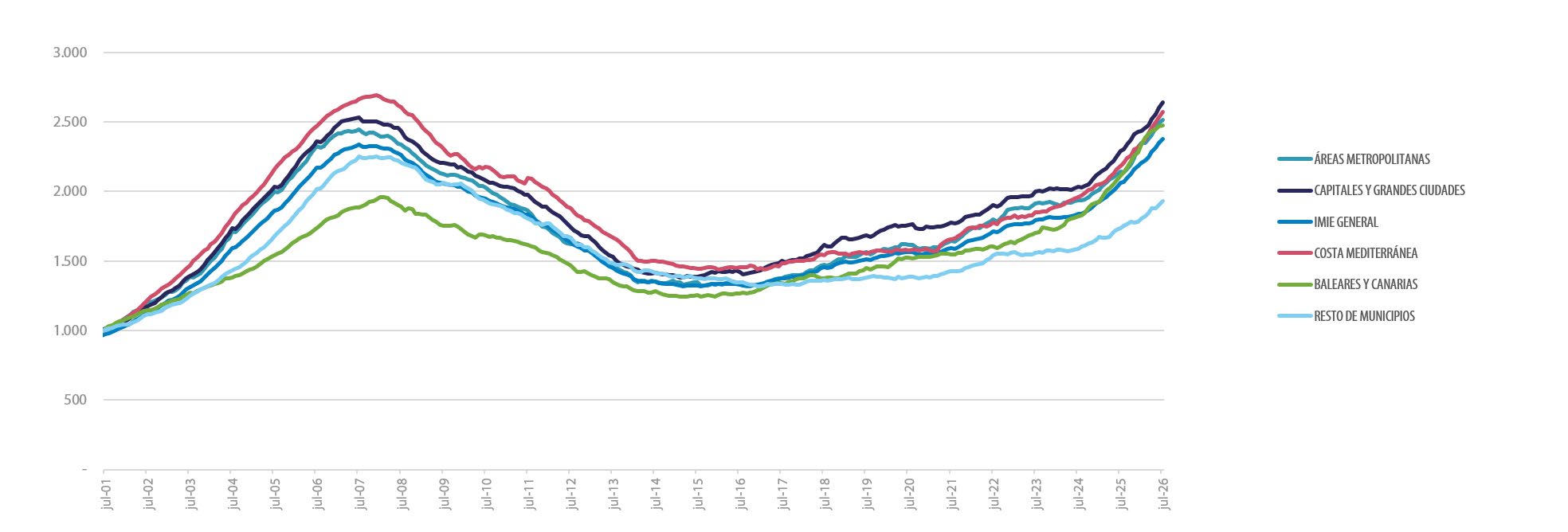
For the past seven months, home prices across Spain have gone up every single month, according to Tinsa, one of Spain’s largest property valuation companies. Tinsa tracks this through a monthly price index, essentially a running scorecard of how much homes are worth compared to previous years.
At the start of 2026, average home values were still about 5 percent below where they stood back in 2007, right before the crash. By June, they had climbed past that old high point for the first time in nearly two decades. By July, prices were running almost 2 percent above the old record.
Prices have also been growing fast compared to a year earlier, between 14 and 16 percent every single month since January. That’s not a short-lived jump. It’s a steady, seven-month trend.
The coast, including Marbella, is catching up quickly
Tinsa doesn’t publish a number specifically for Marbella. The closest thing available is a wider category called “Costa Mediterránea,” which covers coastal towns along the Mediterranean, including the Málaga province where Marbella sits. It’s not a perfect stand-in for Marbella alone, but it’s the best publicly available signal for how the coast is moving.
And the coast has had a strong year:
| Month | Growth compared to a year earlier | How far below the 2007 record |
|---|---|---|
| January | 14% | 13% below |
| February | 15% | 12% below |
| March | 17% | 10% below |
| April | 17% | 9% below |
| May | 18% | 7% below |
| June | 17% | 6% below |
| July | 18% | 5% below |
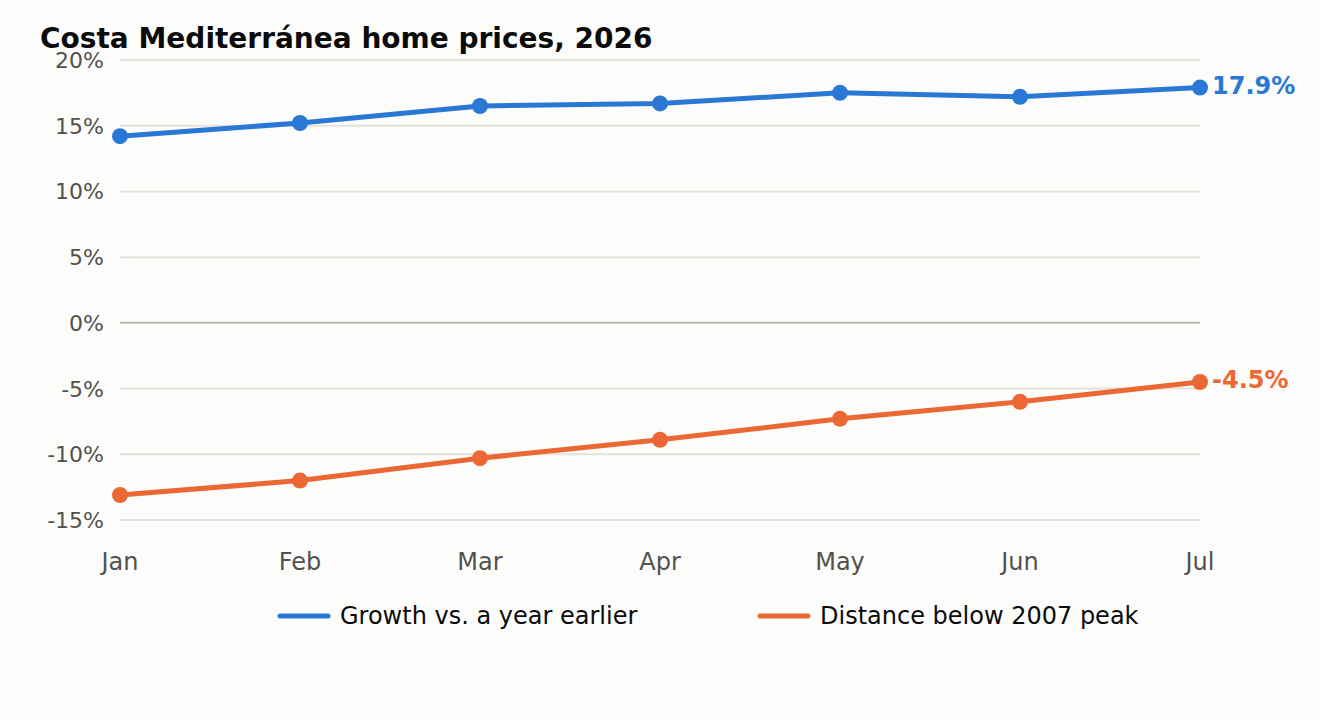
Two things stand out. First, growth has been accelerating almost every month, not slowing down. Second, the gap to the old 2007 record has nearly closed, from 13 percent below in January to under 5 percent below by July. If that pace continues, the coast could hit a brand new record high sometime around the end of 2026 or the start of 2027, the first time that will have happened in almost twenty years.
Marbella itself shows up by name in Tinsa’s data, too. In its first-quarter 2026 report, Tinsa singled out Marbella as one of the few towns in the entire country where prices grew more than 20 percent compared to a year earlier, putting it in the same small group as Sagunto and Benidorm. That’s a sharper number than the wider coastal average above, and it’s the closest thing to an official, Marbella-specific figure Tinsa has published this year.
Part of why the coast is closing that gap faster than the rest of the country comes down to who’s actually buying here. Spain isn’t really one property market, it’s several running side by side, and the Costa del Sol’s is driven by international, largely cash-based demand rather than the domestic mortgage market that shows up in the national mortgage figures below.
Prices are rising, but fewer people are actually buying
This is the part of the story that’s easy to miss if you only look at prices going up.
At the end of 2025, the number of homes actually being sold across Spain was growing too, up almost 8 percent from the year before. Then, starting in January 2026, that flipped. Sales have been down almost every month since: down 5 percent in January, down slightly in February and April, down more sharply in March, and down over 7 percent in May, the weakest month of the year so far. Mortgage lending followed the same pattern, going from strong growth at the end of 2025 to essentially flat, then negative by May, meaning fewer new home loans were being taken out than the year before.
So what does that mean? Prices are climbing not because everyone is suddenly buying, but because there simply isn’t much on the market to buy. Fewer sales are happening overall, but the ones that do close are going for more money. We’ve made the case before that this kind of scarcity-driven growth is a fundamentally different animal from the credit-fuelled run-up that preceded 2008, and the mid-2026 numbers are a live demonstration of exactly that pattern. It also matches what Marbella’s market usually looks like, since a large share of buyers there pay in cash or borrow relatively little, so they’re less exposed to what’s happening with interest rates.
Borrowing got more expensive all year
Mortgage rates in Spain are tied to a benchmark called the Euribor. Think of it as the base cost of borrowing money that banks use to set mortgage rates. Through 2026, that base cost climbed steadily, from about 2.2 percent in January to nearly 2.9 percent by July. At the same time, general inflation also picked up, from 2.3 percent in February to 3.5 percent by July.
Put together, it became noticeably more expensive to take out a mortgage in Spain over the course of the year. That’s a big part of why fewer people were borrowing to buy, even while prices kept rising. It’s also why buyers who don’t need to borrow much, which describes a large share of Marbella’s buyer base, have kept the local market moving in a way the national mortgage numbers alone wouldn’t suggest.
What to watch for the rest of 2026
A few things worth keeping an eye on as the year continues:
- A new record high on the coast. At the current pace, the coastal market, including Marbella’s area, could pass its old 2007 record within the next few months, something that hasn’t happened in almost twenty years.
- Whether borrowing keeps getting more expensive. Seven straight months of rising rates is a real trend now. If it continues, expect fewer buyers to rely on mortgages, even as prices hold up.
- How much new housing gets built, and how much of it is actually worth buying. The most recent clear data, from January 2026, showed new building permits up nearly 20 percent from the year before. More recent figures aren’t available yet due to reporting delays, but this is the number that will eventually decide whether prices can keep climbing at this pace once the market fully catches up to its old 2007 high. Volume alone won’t settle it either, since most of what gets built on this coast follows the same handful of templates, and it’s the thin layer of genuinely well-built projects that tends to hold its value regardless of what the wider index does. Real de La Quinta in Benahavís is a good example of a developer taking that approach deliberately, releasing its master-planned mountain resort in phases rather than rushing supply. September brought two more signs of that confidence: Marbella approved a 156-home development at La Cañada and a 200 million euro expansion of the La Bajadilla marina, both projects that took years to clear planning and permitting.
Nothing in this data points to a slowdown yet. It points to a market that’s been quietly repricing itself all year, with fewer sales but tighter supply, a shift that’s easy to miss if you only glance at the headline growth number.
Questions people are asking
Has the Marbella property market recovered from the 2008 crash?
Spain’s overall market fully recovered in June 2026, reaching a new record high for the first time since 2007. The wider coastal region that includes Marbella is close behind and could reach its own new record by late 2026 or early 2027.
Why are prices rising if fewer homes are selling?
Fewer homes have been sold across Spain every month since January 2026, while prices keep climbing. That usually points to a shortage of homes for sale rather than everyone suddenly rushing to buy. It’s also typical in markets like Marbella, where many buyers pay cash and aren’t as affected by borrowing costs.
How much have coastal property prices grown in 2026?
The coastal price index grew from 14 percent higher than a year earlier in January to 18 percent higher by July, picking up speed nearly every month.
Is now a good time to buy on the Costa del Sol?
Prices are rising and the gap to the old 2007 record is closing fast, which historically hasn’t been the moment prices pause. Borrowing has also gotten more expensive this year, so buyers who don’t need a large mortgage are in a stronger position right now.
Why has it gotten more expensive to get a mortgage in 2026?
The Euribor, the benchmark that Spanish mortgage rates are based on, rose from about 2.2 percent in January to nearly 2.9 percent by July. General inflation also picked up over the same months, from 2.3 percent to 3.5 percent.
Does anyone track Marbella prices specifically?
Not through a monthly index. Tinsa’s routine monthly reports group Marbella into a broader coastal category alongside other Mediterranean towns. Its quarterly report is more specific: in the first quarter of 2026, Tinsa named Marbella directly as one of the few towns nationwide where prices rose more than 20 percent year over year.
Source: Tinsa IMIE General y Grandes Mercados, monthly reports, December 2025 through July 2026, and Tinsa IMIE Mercados Locales, first-quarter 2026 report.
Some of the biggest names on the coast back this outlook with money, not just sentiment — the Saudi royal family is expanding its Marbella estate, while Puerto Sotogrande was just ranked Spain’s fifth largest marina. For the wider regional picture, see why the coast is a different property market from the rest of Spain.
 English
 Spanish
 Dutch
Dutch French
 Polish
 Swedish
 German