
 ES
 NL
 FR
 PL
 SV
 DE
What is Puerto Banús?
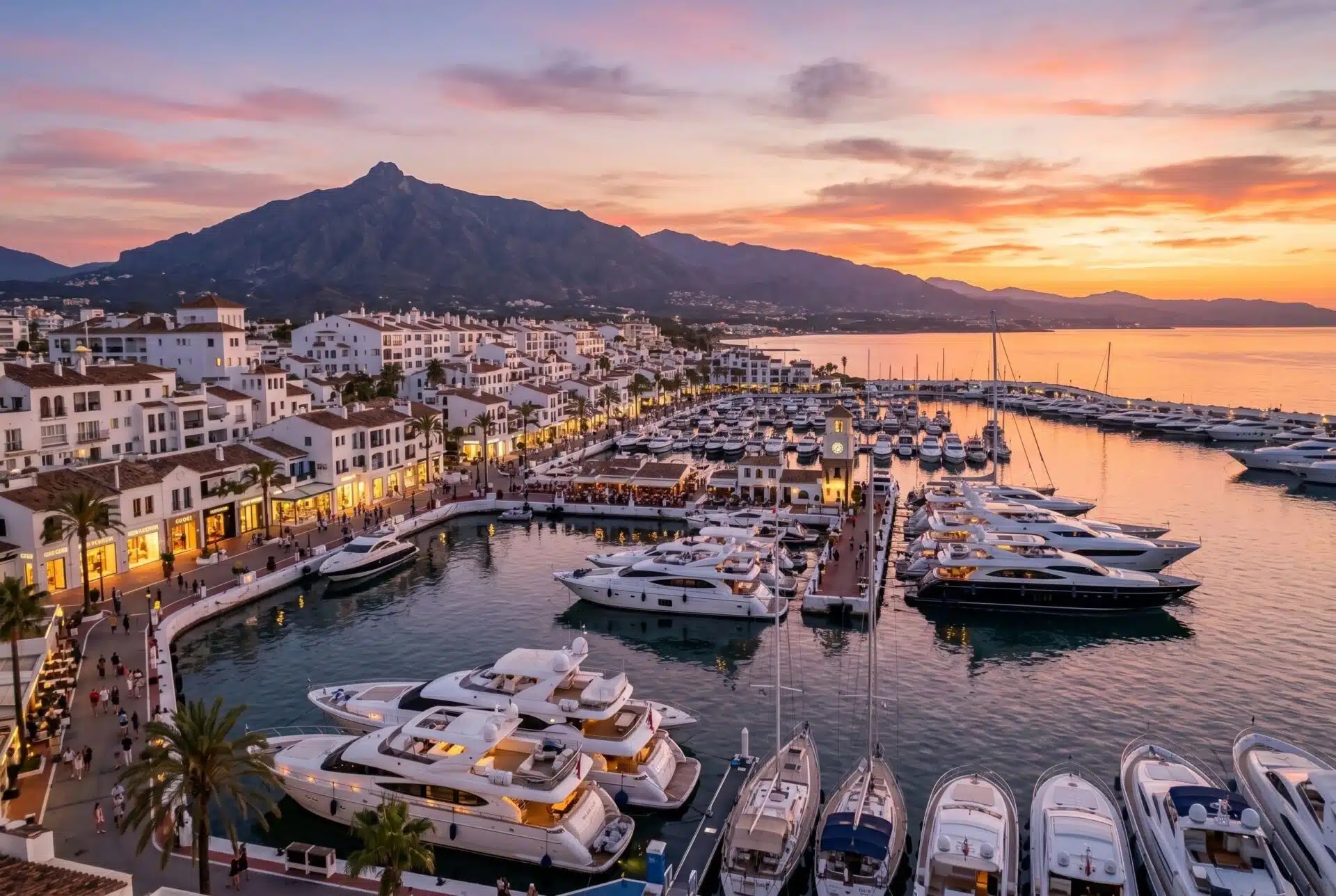
Puerto Banús is not just a marina: it is a brand, a lifestyle shorthand recognised from Moscow to Riyadh to Mayfair. Built in 1970 by local property developer José Banús and inaugurated with a party attended by the Aga Khan, Roman Polanski and Julio Iglesias, the port has spent five decades cementing its reputation as the Mediterranean's most glamorous berth. Today it holds over 900 moorings, including slips for superyachts exceeding 50 metres, and its quayside boulevard is lined with flagship boutiques from Dior, Louis Vuitton, Dolce & Gabbana and Bulgari. Behind the designer glass fronts sits a surprisingly compact residential neighbourhood: a grid of low-rise apartment blocks, a handful of beachfront complexes, and, climbing the hillside toward Nueva Andalucía, a scattering of villas with panoramic views over the port and out to sea. For buyers, the critical distinction is between port-side and hillside. Port-side apartments, particularly those along the Muelle de Honor or fronting the main quay, offer front-row views of the yachts and the Sierra Blanca backdrop, but they also come with weekend noise from the clubs and bars that line the strip, especially from June to September.
Hillside properties, just a five-to-ten-minute walk up toward Nueva Andalucía, trade the buzz for quiet streets, private pools and genuinely usable outdoor space, while remaining close enough to stroll down for dinner. Playa de Puerto Banús, the wide sandy beach immediately west of the port entrance, is an underrated asset: clean, serviced by several beach clubs including Océano Beach and La Sala by the Sea, and far less crowded than the beaches of central Marbella. The Levante beach area to the east of the port is quieter still and popular with families. Connectivity is strong: the A-7 coast road and AP-7 motorway are minutes away, Málaga airport is a 45-minute drive, and the commercial hub of San Pedro de Alcántara sits just three kilometres west with everyday supermarkets, pharmacies and schools. Puerto Banús delivers a rare proposition: the ability to live within walking distance of world-class dining, shopping and nightlife while retreating to a residential street that feels nothing like a resort.
The Marina
The marina at Puerto Banús holds 915 berths and can accommodate vessels up to 50 metres, though during the summer months superyachts far exceeding that length anchor just offshore and tender in. The quayside boulevard stretches roughly 800 metres from the port entrance to the far western dock, and on any given evening it functions as an open-air stage where diners at waterfront restaurants watch the yachts while passers-by watch the diners. The residential apartments that overlook this scene, particularly those on the upper floors of the blocks fronting the Muelle de Honor, command some of the highest per-square-metre prices on the Costa del Sol, justified by views that are genuinely unique in southern Spain.
Living directly on the port is not, however, without compromise. From Thursday to Sunday between June and September, the bass from nearby clubs carries across the water, and the boulevard below stays busy until three or four in the morning. Street cleaning crews move through before dawn, and by mid-morning the cycle begins again. Owners who treat these apartments as summer residences or short-term rentals tend to embrace the energy; those seeking year-round tranquillity are better served one or two streets back, where the noise drops off sharply. The marina itself is well managed by the port authority, with 24-hour security, CCTV coverage and a dedicated harbourmaster's office. For owners with boats, the berthing fees are significant but competitive with comparable Mediterranean marinas, and the social infrastructure (chandlers, marine engineers, provisioning services) is well established.
Shopping & Nightlife
The retail offering at Puerto Banús is concentrated along the front line of the port and the streets immediately behind it. Bulgari, Louis Vuitton, Gucci, Versace, Dolce & Gabbana and Dior all maintain permanent boutiques here, and during peak season several brands operate pop-up installations. Beyond the luxury flagships, there are dozens of smaller shops selling resort wear, jewellery and leather goods, plus the El Corte Inglés department store on the eastern edge of the port area with a gourmet food hall and electronics section. Centro Plaza, a short walk inland, adds everyday retail including pharmacies, a Mercadona supermarket and a selection of casual fashion brands. The shopping scene is functional as well as aspirational: you can buy a Birkin bag and a box of dishwasher tablets within the same fifteen-minute walk.
Nightlife is the other pillar of the Puerto Banús brand. The clubs and bars cluster along the western end of the port and the streets running parallel. Pangea and Sinatra are long-standing late-night venues drawing a dressed-up international crowd, while La Sala and its terrace bar function as all-evening social hubs where dinner transitions into DJ sets without anyone needing to change venue. Buddha Bar Beach, on the sand west of the port, offers a more relaxed sunset-to-midnight format. Linekers Bar provides a louder, more British-inflected experience. The scene is undeniably seasonal (from November to March many venues close or operate on reduced hours) but the core restaurants and a handful of bars remain open year-round, giving permanent residents enough options without the summer crowds. For buyers, the key consideration is proximity: an apartment overlooking the port puts you in the middle of the action, which is either the entire point or a serious drawback depending on your tolerance for a 2 a.m. soundtrack.
Property as Investment
Puerto Banús properties benefit from a level of brand recognition that few addresses on the Costa del Sol can match. The name alone drives search traffic, rental enquiries and resale interest, which translates into tangible investment performance. Short-term rental yields for well-presented two-bedroom port-side apartments routinely reach 5 to 7 per cent gross during peak season, with occupancy rates above 85 per cent from May to October. The rental market softens in winter, but annual gross yields of 4 to 5 per cent remain achievable for properties marketed effectively on premium platforms. Capital appreciation has been steady rather than spectacular: prices recovered their pre-2008 levels around 2021 and have continued to climb, driven by constrained supply (there is very little new-build land remaining near the port) and sustained international demand. Hillside villas toward Nueva Andalucía offer larger lots and better year-round liveability, often appealing to families who rent seasonally and occupy the property themselves for several months a year. The strongest long-term holds tend to be front-line port apartments with unobstructed marina views and villas with sea views on the first ridge behind the port, both benefiting from scarcity and the enduring pull of the Puerto Banús name.
Puerto Banús in 2026
Two things are changing around the port. The first is the coast path: Marbella finished the Senda Litoral link between San Pedro de Alcántara's promenade and Puerto Banús, so you can now walk or cycle from San Pedro through the port and on past Río Verde and Nagüeles to the Golden Mile, which we walked in our coastal path post. The second is the neighbouring port. La Bajadilla, Marbella's other marina, has a new concession holder putting more than 200 million euros into an expansion from 268 to about 750 berths, with room for cruise ships and yachts up to 70 metres, in our post on the La Bajadilla expansion. It does not touch Banús directly, but it adds berths to a town where moorings have been scarce for years. Prices in Marbella rose more than 20 percent year on year in the first quarter of 2026 according to Tinsa, one of the few towns in Spain to do so, which we explain in our Marbella market post. At the time of writing (October 2026) we have four homes tagged to Puerto Banús: a three bedroom apartment at about 2.95 million euros, two five bedroom villas at about 3.65 and 5.75 million, and a seven bedroom house at Lorea Playa at about 2.4 million, all on our Marbella property page; there is no new development inside the port itself, and the Marbella projects are on our Marbella new developments page. Golf is behind the port in the valley: Las Brisas is private, with a 35,000 euro joining fee plus 4,000 a year, Aloha asks visitors for a handicap certificate and Los Naranjos sells memberships from 3,360 euros, all in our golf courses guide. The areas around the port each have a guide: Nueva Andalucía, Las Brisas and Aloha inland, the Golden Mile and Puente Romano to the east, San Pedro de Alcántara and Nueva Alcántara to the west, and the town as a whole in our Marbella guide.
Where is Puerto Banús?
Who lives in Puerto Banús?
Puerto Banús draws one of the most internationally diverse communities on the Costa del Sol. The port has long been a magnet for Middle Eastern visitors and residents: Saudi and Emirati families who return every summer, often for extended stays in rented or owned villas behind the port. A significant Scandinavian population, particularly Swedish and Norwegian, has been established since the 1980s and tends to live year-round in the hillside urbanisations connecting to Nueva Andalucía. British and Irish residents remain a large contingent, drawn by the familiar restaurant scene and English-speaking infrastructure. Russian buyers arrived in numbers during the 2000s, and while that flow has slowed, the community remains visible. Spanish residents, including business owners, restaurateurs and a handful of celebrities, provide a local core that keeps the neighbourhood functioning outside peak season. The mix shifts dramatically by calendar: in winter, the population is smaller, quieter and dominated by permanent residents who value the mild climate and empty restaurants. From May to September, the seasonal influx transforms the port into a showcase of wealth and nightlife, and short-term rental occupancy in port-side apartments can exceed 90 per cent. Year-round residents tend to gravitate toward the hillside or the streets behind the commercial strip, where life continues at a normal pace even in August. The community is overwhelmingly affluent but surprisingly varied in age: retired couples, young entrepreneurs, families with children at nearby international schools, and a transient population of digital nomads and remote workers who rent apartments for a season.
What can you do in Puerto Banús?
Eat & Drink
Sport & Fitness
Wellness
Kids & Family
Property for sale in Puerto Banús

€2.4M
House · Lorea Playa

€2.95M
Apartment · Marbella - Puerto Banus

€5.75M
Villa · Marbella - Puerto Banus

€3.65M
Villa · Marbella - Puerto Banus
All property for sale in Marbella →
Looking for a new build instead of resale? See new developments in Puerto Banús →
Want to be right by the sea? See frontline beach properties for sale →
New developments near Puerto Banús

Isla Bela
Marbella

Sotomar by the Sea
Cortijo Blanco

Blume
Nueva Alcantara

Beseven
Cortijo Blanco

Avenue Marbella
Nueva Andalucia
See all new developments in Marbella →
Frequently Asked Questions
Is Puerto Banús too noisy to live in year-round?
It depends entirely on your exact location. Apartments directly overlooking the main port boulevard experience significant noise from clubs and bars on Thursday to Sunday nights between June and September. Properties one or two streets back, or on the hillside toward Nueva Andalucía, are noticeably quieter. In winter the port is calm and most venues operate on reduced hours, making year-round living comfortable for the majority of residents.
What is the difference between port-side and hillside properties?
Port-side properties are apartments and penthouses in low-rise blocks fronting the marina, offering yacht views and walkable access to restaurants and shops. They are typically smaller, noisier in summer and command premium prices per square metre. Hillside properties toward Nueva Andalucía are detached villas or townhouses with private gardens and pools, offering more space and quiet but requiring a short drive or uphill walk to reach the port.
Can I walk everywhere in Puerto Banús?
The port area itself is very walkable: restaurants, shops, the beach and the marina are all within a 10-minute radius on foot. However, supermarkets, schools and medical facilities require a car or taxi. San Pedro de Alcántara, three kilometres west, has the nearest full-service commercial centre. A car is not essential for daily life but is useful for errands and exploring the wider coast.
What are the rental yields like for Puerto Banús apartments?
Well-presented two-bedroom apartments near the port can achieve gross rental yields of 5 to 7 per cent during peak season, with strong occupancy from May to October. Annual gross yields typically settle around 4 to 5 per cent when accounting for the quieter winter months. Front-line port views, modern finishes and proximity to the beach are the main drivers of premium nightly rates.
Is Puerto Banús suitable for families with children?
Yes, particularly for families willing to live on the hillside rather than directly on the port. Several international schools are within a 10-minute drive, including Aloha College and Swans International. The Levante beach east of the port is family-friendly with shallow water. The port itself is safe and well-patrolled, though the nightlife atmosphere in summer may not suit families with young children seeking a quiet residential feel.
How far is Puerto Banús from Marbella centre?
Puerto Banús sits approximately seven kilometres west of Marbella's old town along the Golden Mile. The drive takes about 10 minutes outside peak traffic hours, though summer congestion on the coast road can double that. Several bus routes connect the two, and taxis are readily available. Many residents consider Puerto Banús and Marbella as part of one continuous urban stretch rather than separate destinations.
What is the community like outside summer season?
From October to April, Puerto Banús transforms into a quieter, more residential neighbourhood. Many seasonal businesses close or reduce hours, and the port boulevard is calm enough for morning walks. The year-round community is a mix of retired Europeans, Spanish business owners and remote workers. Restaurants like La Sala and several cafés stay open, and the mild winter climate, averaging 16 to 18 degrees, keeps outdoor life active.
Are there new-build developments available in Puerto Banús?
Very few. The area immediately around the port is largely built out, and planning restrictions limit new construction near the waterfront. Most available stock is resale, ranging from 1970s-era apartments that need full renovation to recently refurbished penthouses. New-build options are more commonly found on the hillside toward Nueva Andalucía or in adjacent areas like San Pedro de Alcántara and the New Golden Mile.
Is there a pharmacy in Puerto Banús?
Yes. La Para-Farmacia del Puerto sits on Avenida de Julio Iglesias, close to the marina.
How far is Puerto Banús from Málaga airport?
About 65 kilometres, or 45 minutes by car on the AP-7 toll road, a little more on the free A-7 in summer. Gibraltar airport is about 80 kilometres and 55 minutes the other way. There is no train; the interurban bus along the coast stops at the port.
Which beaches are next to Puerto Banús?
Playa de Puerto Banús is two minutes on foot from the port, with the beach clubs along it, and Playa de Levante is five minutes east towards Marbella. The coast path now runs unbroken from San Pedro de Alcántara through the port and east past Río Verde and Nagüeles, so you can walk the whole stretch along the water.
What does a home in Puerto Banús cost in 2026?
In our stock, apartments inside and behind the port start just under 3 million euros for three bedrooms and villas run from about 3.65 to 5.75 million. Smaller apartments in the blocks behind the port sell for less through other agents, but the front line and the port itself are the most expensive square metres in Marbella outside the Golden Mile.
Is Puerto Banús popular with Scandinavian buyers?
Yes, and it has been since the 1980s. Swedes and Norwegians were among the first foreign owners around the port and there is still a Scandinavian community in Nueva Andalucía behind it, with Swedish schools, churches and shops in the area. Our Nueva Andalucía guide covers that side in detail.
Not sure which area suits you?
Find your perfect area
Take our Zone Finder quiz and we will match you to one of the 65+ zones we cover.
Take the Zone Finder quiz →Interested in Puerto Banús?
Our team knows this area inside and out. Let us help you find the right property.
Contact Us English
 Spanish
 Dutch
 French
 Polish
 Swedish
 German