
 ES
ES NL
NL FR
FR PL
PL SV
SV DE
DE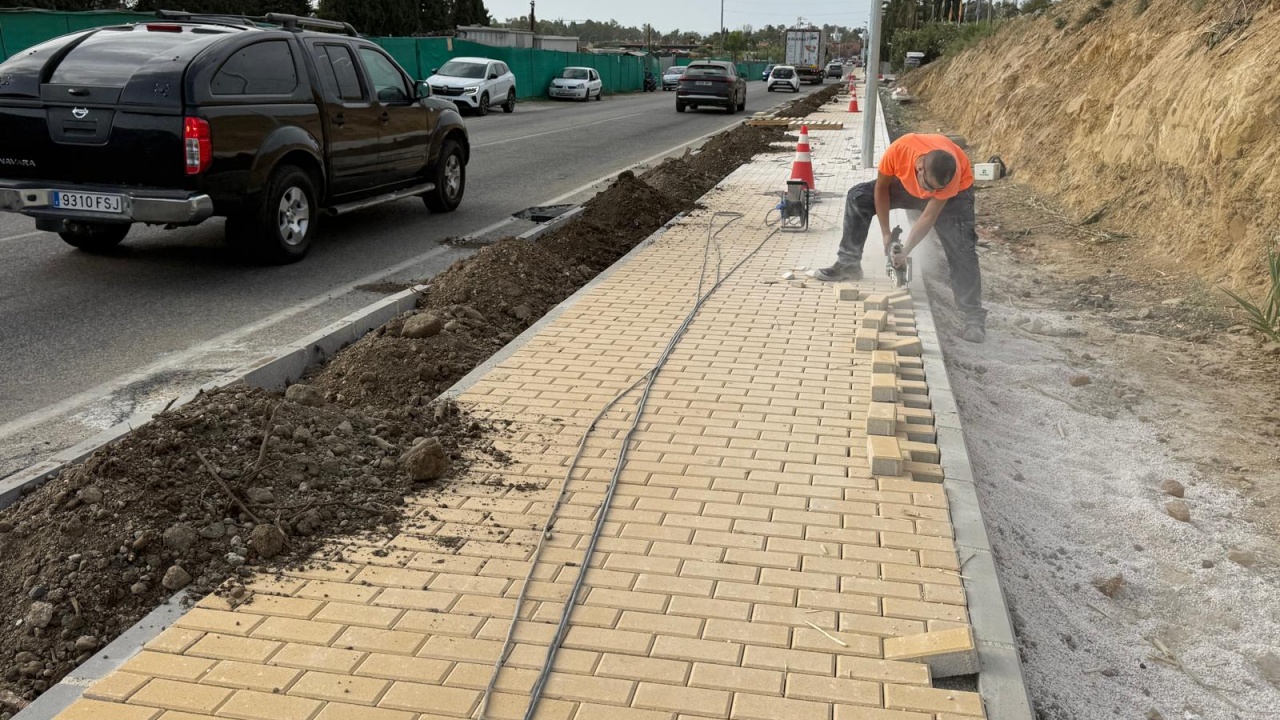
The new pavement along the urban stretch of the Benahavís road is more than 90 percent complete, Estepona town hall has confirmed. What’s left is tree planting, landscaping and a few finishing touches. Once done, it gives La Alquería and Atalaya a lit, continuous footpath running 2.3 kilometres from the A-7 to Avenida La Alquería, replacing years of walking on the verge or not walking at all.
What the project actually delivers
The works cover the stretch between the Mar y Monte roundabout, just off the A-7, and the La Alquería roundabout at the top. With a budget of 1,358,000 euros, the town hall has built a continuous sidewalk along the eastern side of the road, together with street lighting, rainwater drainage, and traffic calming measures to slow the cars that use this road as a shortcut into the hills.
That last point matters as much as the pavement itself. This has always been a quick road, and anyone living in the urbanisations along it knows the feeling of pulling out of a gated entrance onto a carriageway where traffic moves faster than it should. Calmer traffic and a lit footpath change the character of the whole corridor. And it’s accessibility as much as safety: a continuous, level pavement means the road works for pushchairs, wheelchairs and evening walkers, not just for cars.
Why it took this long
The short answer is ownership. Until recently this stretch belonged to the Junta de Andalucía, which meant Estepona couldn’t touch it no matter how often residents asked. The regional government formally transferred the 2.3 kilometre urban section to the municipality a few months ago, and the town hall moved quickly once the paperwork cleared. It’s a pattern we’ve seen before in Estepona: once a road becomes municipal, investment follows fast.
The town hall is presenting this as one piece of a wider programme of upgrades across every neighbourhood in the municipality, from the town centre out to the residential fringes. Whatever you make of the politics, the results on the ground are hard to argue with. Estepona has spent a decade turning connective spaces, streets, boulevards and now this road, into places people actually want to use.
A corridor with more going on than people realise
The Benahavís road is easy to underestimate. It looks like a connector, but it threads together some of the most liveable golf territory on this part of the coast. Atalaya sits at the bottom of the road with its two 18-hole courses and country club, and El Paraíso Golf, the Gary Player design, is a few minutes west. Colegio Atalaya, the bilingual school teaching children from age three through to eighteen, is right in the middle of the corridor. Keep driving north and you reach Benahavís village and its restaurants in about ten minutes.
And the amenities are still growing. At the foot of the road, Patio de Tramores is bringing a new neighbourhood shopping centre to the corridor: a dozen units built around a curated mix of shops, restaurants and family spaces. The architecture is worth a mention in its own right, all arches, stone, timber and planting, designed to sit quietly in the landscape rather than announce itself. For residents of La Alquería and Paraíso Alto, that means daily errands, a coffee or dinner without getting on the A-7 at all. Once the new sidewalk connects the urbanisations to it, some of those trips won’t even need a car.
What it means for owners and buyers
Infrastructure like this rarely makes headlines, but it quietly changes how an area lives and how it’s valued. A villa in La Alquería that once felt car-dependent now sits on a corridor where you can walk to the golf club, walk the kids some of the way to school, or stroll down to a shopping centre. Buyers notice that, and so does the market over time.
The timing is good for the area’s new stock too. Developments such as Atalaya Emotion sit within this same corridor, and every euro the town hall puts into pavements, lighting and trees makes the surroundings match the quality of what’s being built.
The trees go in next, and then the corridor between the coast and Benahavís will finally feel like the residential spine it has been in practice for years. If you’d like to know more about living along this stretch, our area guides for Atalaya, La Alquería and Paraíso Alto are a good place to start.
Benahávis isn’t the only town investing in its infrastructure. Estepona has broken ground on its own velodrome, football and rugby complex.
Questions people are asking
Is the Benahavís road sidewalk project finished?
More than 90 percent complete as of this update, with tree planting and landscaping left to finish. The continuous, lit footpath runs 2.3 kilometres from the A-7 to Avenida La Alquería.
Why did it take so long to build a sidewalk on this road?
The road belonged to the Junta de Andalucía until recently, so Estepona’s town hall had no authority to invest in it. Once the region formally transferred the urban section to the municipality, works moved quickly.
What areas does the Benahavís road connect?
Atalaya and La Alquería at the coastal end, up through Paraíso Alto and on to Benahavís village, passing Atalaya’s two golf courses, El Paraíso Golf and Colegio Atalaya school along the way.
Does the project include anything besides the sidewalk?
Yes: street lighting, rainwater drainage, and traffic calming measures to slow the road, which residents have long used as a fast shortcut into the hills.
What new amenities are coming to this corridor?
Patio de Tramores, a new neighbourhood shopping centre with around a dozen units of shops, restaurants and family spaces, at the foot of the road near Atalaya.
 English
 Spanish
 Dutch
Dutch French
 Polish
 Swedish
 German