
 ES
 NL
 FR
 PL
 SV
 DE
Puerto Banús is about to get a new shareholder for the first time in more than four decades. On 5 November 2026 El Confidencial reported that the British investment firm ICG (Intermediate Capital Group) is finalising a deal to buy the company that runs the Marbella marina, after winning a closed process open to only a handful of investors. According to the paper’s sources, the deal is for 100% of the company at a value of around 150 million euros including earn-outs, ICG’s financing is already in place, and signing is planned for December. The Vidiella family will reinvest in the company. Puerto Banús itself has only confirmed that it is bringing in a strategic investor and that talks are at an advanced stage.
Since 1983 the port has been controlled by one family, the Vidiellas. This post covers what has been reported so far, who ICG is, how the port passed from José Banús to his nephew, the 1991 fight with Jesús Gil, and what the deal does and does not change for people who own homes around the port.
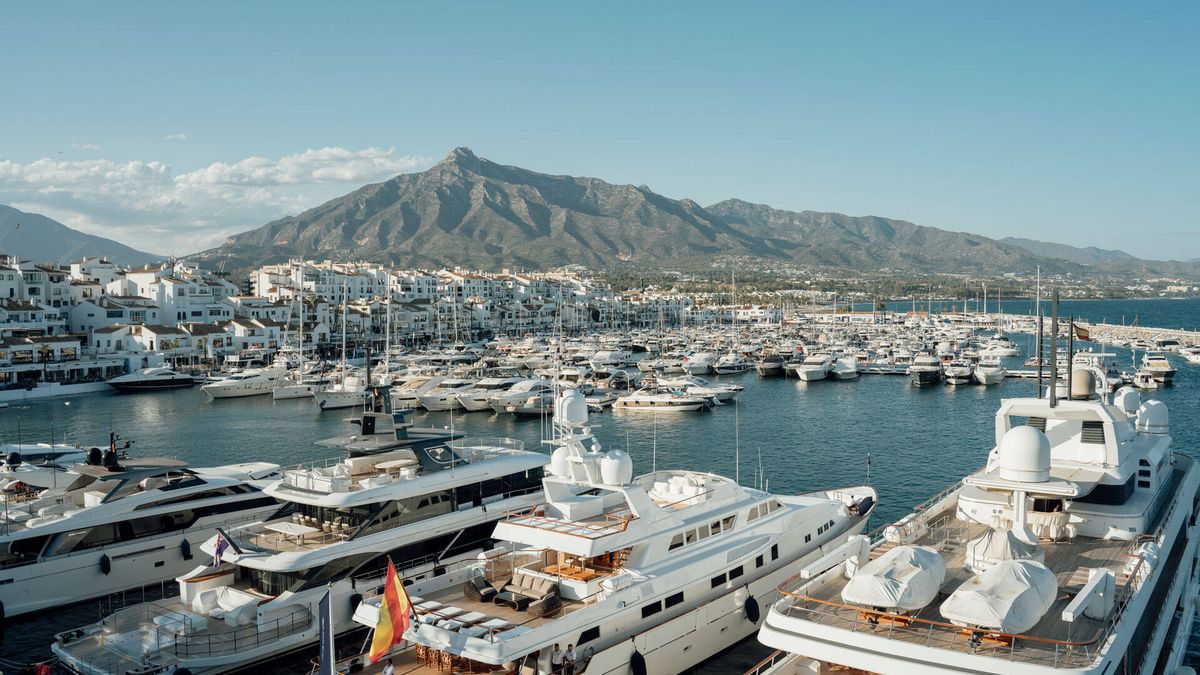
What has been reported about the Puerto Banús deal
The sale process became public in April 2026. Expansión, Forbes and El Estrecho Digital reported that the Vidiella family had hired EY as financial adviser to look for a financial partner. The plan was to combine the sale of a block of shares with a capital increase, so that new money goes into the company and not only to the family. The process was kept confidential and limited to investors who specialise in infrastructure.
At the time the port was careful with the wording. Sources at Puerto Banús told elEconomista on 9 April that “no hay nada a la venta” (nothing is for sale) and described the operation as a capital increase, with the family keeping control. Other outlets wrote that the new partner could end up with a majority. Seven months later, El Confidencial says ICG made the best offer and that its entry ends the family’s sole control of the port.
The paper’s financial sources describe the deal as a sale of 100% of the company, valued at around 150 million euros once earn-outs are included. Earn-outs are later payments that depend on the business hitting targets, so part of that figure is linked to the expansion plan working. The shareholder structure is still being finalised, and the family will put part of the money back into the company.
Puerto Banús told El Confidencial it is “inmersos en un proceso de incorporación de un inversor estratégico” (in the process of bringing in a strategic investor) and that negotiations are well advanced. Signing is expected in December 2026. Until then, the figures come from sources close to the deal, not from ICG or the port. We will update this post when the deal is signed.
Who is ICG
ICG is a London-based alternative asset manager founded in 1989 and listed on the London Stock Exchange. It reported around 126 billion US dollars of assets under management at the end of March 2026. It invests through private equity, private debt, real estate and infrastructure funds, and it has raised two infrastructure funds so far.
ICG is not new to Spain. It has backed Spanish companies such as the customer-service group Konecta, and in 2022 its infrastructure arm bought Dos Grados, a renewable energy developer working in Spain and Portugal. A marina operator fits the infrastructure side of the business: long concessions, steady income from berths, parking and commercial rents, and the option to add more marinas over time.
Why the Vidiellas opened the capital
The family says it is not leaving. The company’s CEO, Juan Núñez Insausti, was brought in almost ten years ago to professionalise the management. In an interview with Expansión in April 2026 he said the shareholders are now the third generation, with strong emotional ties to the port, and that whether they keep a majority or move to a minority depends on how much capital comes in. The November reports describe a sale of 100% with the family reinvesting, so the Vidiellas stay on as shareholders. The current management team is expected to stay. He also said the talks were with infrastructure funds and investors that build platforms of several assets, and ruled out industrial partners. ICG fits that description.
The reason for the new money is expansion. Since the family professionalised the management, Núñez says he has grown parking income about fivefold and rental income about fourfold, taking turnover to roughly 20 million euros and EBITDA to around 10 million euros a year. The target is to double the business in four to five years and reach 20 million euros of EBITDA.
To get there, Puerto Banús wants to stop being a single marina and become an operator of several. The stated plan is five marinas by 2030, focused on Spain, and fifteen by 2035, with expansion into Europe and mainly the Mediterranean. It is looking at new concession tenders and at buying existing marinas, and it has added two newer business lines: a port consultancy service for other marinas and brand events. Núñez compares the opportunity to the Spanish parking sector twenty years ago, before it consolidated.
Until recently, marinas were a fragmented business run mostly by families. That is changing fast, and the big funds are buying:
| Fund | Deal | Reported value |
|---|---|---|
| Blackstone | Safe Harbor Marinas (2025), which then bought Monaco Marine | 5.65 billion US dollars |
| Blackstone | MarineMax, agreed, closing expected before the end of 2026 | 1.5 billion US dollars |
| InfraVia | D-Marin from CVC, 26 marinas in Europe and the Emirates (agreed July 2026) | Over 1 billion euros |
| Stonepeak | Southern Marinas from KSL (April 2026) | Not reported |
| Centerbridge | Exploring the sale of its minority stake in Suntex Marinas (US) | Valuation of about 4 billion US dollars |
| ICG | Puerto Banús (signing expected December 2026) | Around 150 million euros with earn-outs |
Closer to home, talks between Blackstone and Squircle Capital over the Barcelona superyacht shipyard MB92, valued at more than 500 million euros, have stalled over price and strategy. Squircle has owned all of MB92 since March, has extended its concession in the port of Barcelona to 2050 and has announced a 40 million euro investment, and other funds are now contacting advisers to follow the process. Puerto Banús is small next to these platforms, but it has a name that none of them have. ICG is buying the brand and the plan to put it on more marinas.
Puerto Banús in numbers
| Item | Figure | Source |
|---|---|---|
| Berths | 915, full every high season | elEconomista, April 2026 |
| Boat length | 8 to 50 metres | Port data |
| Reported deal value | Around 150 million euros for 100%, including earn-outs | El Confidencial, Nov 2026 |
| Company turnover | About 20 million euros a year | Expansión, Forbes, El Estrecho Digital |
| EBITDA | About 10 million euros a year | Same reports |
| EBITDA target | 20 million euros in four to five years | CEO Juan Núñez Insausti |
| Luxury brands on the port | 42, in about two kilometres | Puerto Banús, via elEconomista |
| Sales of those brands in 2025 | 310 million euros, around 75% to international buyers | Puerto Banús, via elEconomista |
| Expected sales growth in 2026 | Close to 5% | Puerto Banús, via elEconomista |
| Concession | 99 years from 1967, expires 2066 | Expansión, Forbes |
| Expansion plan | 5 marinas by 2030, 15 by 2035 | CEO Juan Núñez Insausti |
The port also says it has the highest concentration of luxury shops in Spain and, by square metre, in Europe, with names such as Hermès, Dior, Louis Vuitton, Dolce & Gabbana and Fendi. There are no empty units left. “No tenemos locales disponibles,” the port told elEconomista.
Which luxury brands are in Puerto Banús
The shops are the reason most visitors come, and the rents they pay are a large part of what ICG is buying. These are the brands with their own store on the port, all checked as open on Google Maps on 6 November 2026. Most sit on Calle Muelle Ribera, the quay facing the yachts, with a second cluster on Calle Benabola and Muelle de Levante.
Fashion houses: Louis Vuitton, Dior, Hermès, Gucci, Saint Laurent, Celine, Loewe, Fendi, Bottega Veneta, Versace, Dolce & Gabbana, Giorgio Armani, Tom Ford, Salvatore Ferragamo, Etro, Philipp Plein, Billionaire and Dsquared2.
Quiet luxury and menswear: Loro Piana, Brunello Cucinelli, Zegna, Moncler, Jacob Cohen, Santoni, Polo Ralph Lauren, Boss and Lacoste.
Womenswear and shoes: Zimmermann, Veronica Beard, Carolina Herrera, Elisabetta Franchi, Patrizia Pepe, Twinset, Maje, Sandro, Michael Kors, Wolford, Jimmy Choo and Golden Goose.
Jewellery and watches: Bvlgari, a Rolex boutique, Carrera y Carrera, APM Monaco, Gómez & Molina, Ruz Joyeros and Swatch, plus several independent watch dealers.
Beachwear: Vilebrequin and MC2 Saint Barth.
Dolce & Gabbana has gone furthest. It has a women’s store, a separate home store and the Martini Bar by Dolce & Gabbana, all on the port. Fashion names are moving into homes on this coast too, from Armani Residences on the Golden Mile to Design Hills by Dolce & Gabbana, EPIC Marbella by Fendi Casa and the Karl Lagerfeld Villas. Behind the port, El Corte Inglés runs one of its large stores, with an Etro corner and a Hipercor supermarket.
The history of Puerto Banús, from José Banús to the Vidiella family
José Banús and Nueva Andalucía
José Banús Masdeu was born in Masó, in Tarragona, in 1906. He left school at 14 to work with his father, a builder, and together they founded a construction company in Madrid that built large housing estates and the access road to the Valle de los Caídos. That work under the Franco government earned him the nickname “the regime’s builder”.
In the late 1950s he bought land between the Guadaíza and Verde rivers, west of Marbella. In 1964 the government approved his plan for a tourist centre called Andalucía la Nueva, the area we now know as Nueva Andalucía. The marina was meant to be its centrepiece. In 1967 the Ministry of Public Works granted Banús a 99-year concession to build and run it.
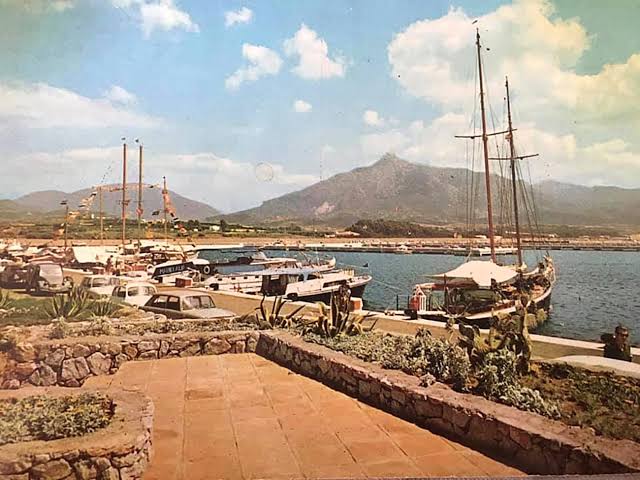
The design that was not built
The first design, by the architect Antonio Lamela, was a semicircle of six 16-storey towers around the water. Prince Alfonso de Hohenlohe, founder of the Marbella Club on the Golden Mile, opposed it, and he brought in the architect Noldi Schreck, who was working in Mexico City. Schreck and his assistant Marcos Sainz drew the low white “Andalusian village” that stands today. Work started in 1965, and the breakwater and heavy civil works were finished by 1968. You can read more about the Hohenlohe years in our history of the Golden Mile.
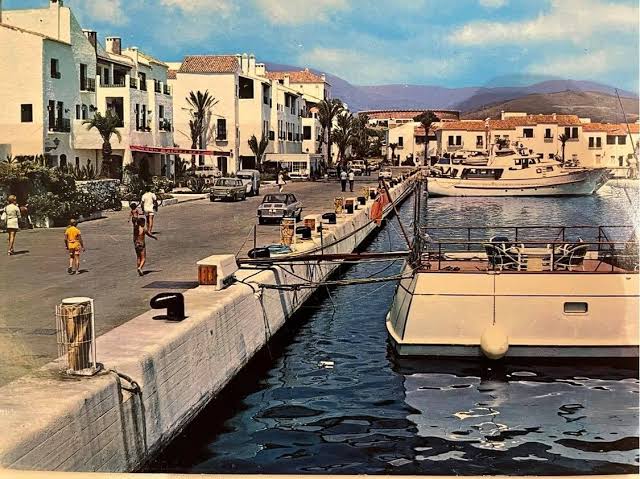
The 1970 opening
Puerto Banús had two openings in 1970: an official one with the authorities on 18 May and a party on 2 August. Around 1,700 guests came to the party, led by Prince Rainier and Princess Grace of Monaco. The Aga Khan, Hugh Hefner, Roman Polanski and the heart surgeon Christiaan Barnard were there, and a young Julio Iglesias was hired to sing. It was the first marina on the Costa del Sol and the first in Spain built with private money.
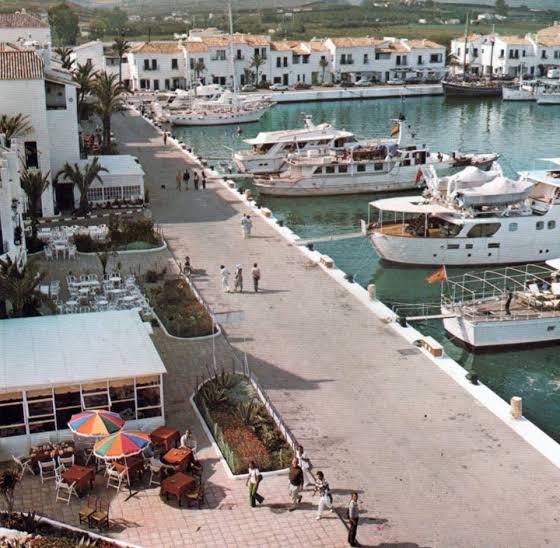
Debt, a Saudi buyer and the hand-over to a nephew
The 1973 oil crisis hit the port hard and it started losing money. In 1978 Banús opened one of Spain’s first casinos after gambling was legalised, but the debts kept growing. In 1980 and 1981 he sold large parts of Nueva Andalucía, including land to a Saudi buyer and the Las Brisas golf course (now in our Costa del Sol golf guide), to avoid foreclosure by the banks. Saudi royals have been regulars in the area ever since, as we wrote in our post on the Saudi royal family’s Marbella estate.
In 1983 his nephew, Alberto Vidiella Tudores, a builder and developer, took over the port company, Puerto José Banús S.A., as president and majority shareholder. José Banús died in Madrid in 1984, aged 78, with no children.
1991: Jesús Gil tries to take the port
In 1991 the then mayor of Marbella, Jesús Gil, tried to take control of Puerto Banús. He used a debt that another group company, Puerto José Banús Andalucía la Nueva S.A., owed the town hall. The fight went to court and lasted years. Drug squad reports and phone taps by the Italian anti-mafia police later suggested that Italian investors were behind the move, using the town hall as an intermediary. Vidiella won in court and kept the port.
From marina to luxury shopping street
By the late 1980s the port was looking tired. In the late 1990s Vidiella started bringing in the big fashion houses, and around 2000 El Corte Inglés and the shops around Plaza Antonio Banderas opened. In 2006 the Junta de Andalucía, which had taken over the concession from the state, raised the yearly fee from 120,000 euros to 1.1 million euros. Vidiella went to court and the increase was phased in between 2006 and 2012.
Alberto Vidiella died in February 2016, aged 82. The town hall unveiled a bust of him at the port that year. His sons José and Rubén Vidiella Salgado became joint vice-presidents, and today the shares are held by the third generation of the family.
Timeline: who has owned Puerto Banús
| Year | What happened |
|---|---|
| Late 1950s | José Banús buys the land between the Guadaíza and Verde rivers |
| 1964 | Plan for Andalucía la Nueva (Nueva Andalucía) approved |
| 1965 to 1968 | Marina breakwater and civil works built |
| 1967 | 99-year concession granted to José Banús, running to 2066 |
| 1970 | Official opening on 18 May, opening party on 2 August |
| 1980 to 1981 | Banús sells large parts of Nueva Andalucía to pay down debt |
| 1983 | Alberto Vidiella Tudores, his nephew, takes control of the port |
| 1984 | José Banús dies, aged 78 |
| 1991 | Jesús Gil tries to take over the port; Vidiella wins in court |
| Around 2000 | El Corte Inglés and the luxury brands arrive |
| 2006 to 2012 | Concession fee rises from 120,000 to 1.1 million euros a year |
| 2016 | Alberto Vidiella dies; his sons take over |
| April 2026 | Family hires EY to find a financial partner |
| November 2026 | ICG reported to be finalising a deal for 100% at around 150 million euros, family to reinvest |
| December 2026 | Signing expected |
What the deal means if you own or are buying near Puerto Banús
The deal is about the company that holds the marina concession and runs the berths, the parking and the commercial premises. The concession itself belongs to the Junta de Andalucía and still runs to 2066. The apartments and villas around the port are privately owned and are not part of the transaction.
What a new investor can change is how the port is run and how much is spent on it. Work is already under way: a 9 million euro project to replace eight pontoons with floating decks is due to finish at the end of 2026. A shareholder whose plan is to grow the Puerto Banús brand across the Mediterranean has every reason to keep the original port in top condition, because it is the showroom for everything else.
For property, Puerto Banús has always been a split market. Port-side apartments get the yachts and the views, and also the noise from the bars in summer. The hillside streets up toward Nueva Andalucía are quieter and have more outdoor space while still being a walk from the port. Our Puerto Banús area guide explains the difference street by street.
Puerto Banús also sits in the middle of some of Marbella’s most popular areas. Nueva Andalucía climbs the hill behind it toward the golf valley, with Las Brisas and Aloha around their golf courses. To the west is San Pedro de Alcántara and the beachfront of Guadalmina Baja. To the east, the Golden Mile and Puente Romano run toward Marbella town. Our Marbella guide covers all of them, and our Marbella property market outlook for 2026 has the prices.
New-build homes we list in Nueva Andalucía, behind the port, include Nikki Living (from 450,000 euros), Terrazas de Guadaiza II (from 564,375 euros), Avenue Marbella (from 5,780,000 euros) and Ocho de Oro (from 11,500,000 euros). You can see the rest on our new developments page and all properties for sale in Marbella.
Marinas along this coast are changing hands and growing. Marbella has approved a 200 million euro rebuild of the La Bajadilla marina, and Puerto Sotogrande is now among the largest marinas in Spain. Big money buying into the coast’s best-known names is also what happened at the Four Seasons Marbella this year.
If you want to talk about buying or selling near the port, or you are not sure which part of the coast suits you, get in touch with us or try Find My Area and our guide on how to choose the right area on the Costa del Sol.
Frequently Asked Questions
Who owns Puerto Banús?
The company that runs Puerto Banús has been controlled by the Vidiella family since 1983, when Alberto Vidiella Tudores took over from his uncle José Banús. The shares are now held by the third generation. In November 2026 El Confidencial reported that the British fund ICG is finalising a deal for 100% of the company, with the family reinvesting and signing planned for December.
Has Puerto Banús been sold?
Not yet, as of 6 November 2026. El Confidencial reported that ICG is finalising a deal for 100% of the company, with signing expected in December. Puerto Banús has confirmed advanced talks with a strategic investor but has not announced terms.
How much is ICG paying for Puerto Banús?
Sources quoted by El Confidencial put the value at around 150 million euros, including earn-outs, which are extra payments tied to future results. Neither ICG nor Puerto Banús has confirmed the figure.
Who is ICG?
ICG (Intermediate Capital Group) is a London-listed alternative asset manager founded in 1989, with around 126 billion US dollars under management in March 2026. In Spain it has invested in companies such as Konecta and the renewable developer Dos Grados.
Will the Vidiella family leave Puerto Banús?
No. Even with a sale of 100% of the company, the family will reinvest and keep a stake, according to El Confidencial. CEO Juan Núñez Insausti told Expansión in April that the family is staying, and the management team is expected to stay too.
Who built Puerto Banús and when did it open?
The developer José Banús built it. The design is by Noldi Schreck and Marcos Sainz, after a tower scheme by Antonio Lamela was dropped. It opened officially on 18 May 1970, with a party on 2 August 1970 attended by Prince Rainier and Grace Kelly.
What luxury brands are in Puerto Banús?
Louis Vuitton, Dior, Hermès, Gucci, Saint Laurent, Celine, Loewe, Fendi, Bottega Veneta, Versace, Dolce & Gabbana, Giorgio Armani, Tom Ford, Bvlgari, Loro Piana, Brunello Cucinelli, Zegna and Moncler all have stores on the port, along with a Rolex boutique. The port counts 42 luxury brands in about two kilometres.
Why is it called Puerto Banús?
It is named after José Banús, the developer who built it. The official name is Puerto José Banús, and the company that runs it is Puerto José Banús S.A.
How many berths does Puerto Banús have?
Puerto Banús has 915 berths for boats from 8 to 50 metres, and the port says they are full every high season.
When does the Puerto Banús concession end?
The 99-year concession was granted in 1967 and runs until 2066. It now sits with the Junta de Andalucía, which took over port powers from the central government.
How much money does Puerto Banús make?
The company makes about 20 million euros a year from berths, rents, parking, hospitality, events and sponsorship, with EBITDA of around 10 million euros. The luxury shops on the port sold 310 million euros in 2025.
Does the deal affect homeowners in Puerto Banús?
Not directly. The deal concerns the company that holds the marina concession, not the privately owned homes around the port. Any effect would come through how the port is run and invested in.
Not sure which area suits you?
Find your perfect area
Take our Zone Finder quiz and we will match you to one of the 79 zones we cover.
Take the Zone Finder quiz →