
 ES
 NL
 FR
 PL
 SV
 DE
Marbella is the flagship municipality of the Costa del Sol, stretching 27 kilometres along the Mediterranean coast between the Sierra Blanca mountains and the sea. Its population reached 173,420 registered residents on the municipal roll (padrón) as of January 2026, up from 156,295 just three years earlier – a gain of over 17,000 people in three years, with more than nine in ten new arrivals coming from outside Spain. Roughly 36% of residents hold a non-Spanish nationality across 155 countries; Morocco is the single largest foreign nationality (over 6,100 residents), followed by large British, Colombian and Northern European communities.
Six distinct sub-markets make up the residential landscape: the western beachside neighbourhoods of Guadalmina and San Pedro de Alcántara, the golf-rich hills of Nueva Andalucía, the prestigious Golden Mile corridor, the historic old town, and the long eastern coastal strip from Los Monteros to Cabopino.
How Marbella Became Marbella
Marbella’s transformation from fishing village to international byword for luxury traces back to 1947, when the Spanish-German aristocrat Prince Alfonso von Hohenlohe bought land here. In 1954 he opened the Marbella Club as a private retreat for friends and their circle – it drew Deborah Kerr, Ava Gardner, Frank Sinatra and a growing roster of European royalty and industrialists, and effectively invented the town’s jet-set reputation. A decade later, developer José Banús built on that momentum: construction on Puerto Banús began in 1965 under architects Antonio Lamela and Noldi Schreck, deliberately designed as a low-rise Andalusian village rather than the high-rise blocks originally proposed, and the marina opened in 1970. Puerto Banús now holds around 915 berths for craft up to 50m, among the most expensive marinas in Europe to moor in.
On the western flank, Guadalmina Baja and Guadalmina Alta offer mature villa plots beside the Guadalmina Golf courses. San Pedro de Alcántara is a genuine Spanish working town with a redesigned boulevard, weekly market and year-round local life. Inland from Puerto Banús, the Nueva Andalucía Golf Valley clusters around Las Brisas, Aloha and Los Naranjos golf clubs, making it one of the densest golf catchments in Europe.
The Golden Mile links Puerto Banús to Marbella old town, lined with the Marbella Club Hotel, Puente Romano Beach Resort and flagship beach clubs. Above it, Sierra Blanca and Nagüeles provide gated hillside estates with panoramic sea views. The Casco Antiguo (old town) centres on Plaza de los Naranjos, laid out in 1485 after Marbella passed peacefully to the Catholic Monarchs; its Renaissance-style town hall, built in 1568, still carries plaques in Old Spanish commemorating the 1485 conquest, and the adjoining Ermita de Santiago is the oldest religious building in the city. Whitewashed lanes, tapas bars and a growing gallery scene fill the streets around it.
East of the centre, the coastline runs through Río Real, Elviria, Santa Clara, El Rosario and Las Chapas, each offering a mix of beachside villas, gated communities and international schools such as Swans and the English International College. Cabopino closes the municipality with a small marina and protected natural dunes. Inland, Palo Alto is a boutique eco-development near the village of Ojén.
Marbella district by district
Marbella is 27 km of coast and at least six markets with one name. Every neighbourhood below has its own guide with distances, schools, what is for sale and what we would tell a client before viewing.
The Golden Mile and the hill above it
The Golden Mile runs from the old town to Puerto Banús, with Puente Romano on the beach side and Lomas de Marbella Club, Nagüeles, Cascada de Camoján and Sierra Blanca climbing the slopes of La Concha behind it. This is the most expensive ground in southern Spain and the one part of Marbella where there is simply no more land.
The centre
Marbella Centro is the old town around Plaza de los Naranjos and the seafront promenade: the walkable option, the best food on the coast and the fewest parking spaces.
Puerto Banús and the Golf Valley
Puerto Banús is the marina, apartments and noise in August. Behind it, Nueva Andalucía is the Golf Valley, where most of our villa sales happen: Las Brisas, Aloha, Los Naranjos and, on the eastern edge beside Los Naranjos golf, the large plots of Haza del Conde.
West: San Pedro and Guadalmina
San Pedro de Alcántara is a real town inside the municipality, with a boulevard, a market and the schools families choose. Nueva Alcántara is its family neighbourhood between town and beach, Linda Vista the flat beachside villa streets on its western edge, and Guadalmina Baja and Guadalmina Alta the mature villa plots either side of the Guadalmina golf courses at the border with Estepona.
East: from Río Real to Cabopino
Marbella East is a different market from the Golden Mile: quieter, greener, with the beach clubs locals use. It runs through Río Real, Los Monteros, Santa Clara, El Rosario, Elviria and Las Chapas to Cabopino, the small port and the Artola dunes at the municipal boundary. Inland, Palo Alto is the boutique hillside development near Ojén.
What has changed in Marbella in 2026
Marbella’s news in 2026 has been about brands and planning. On 20 October the developers of the Las Dunas plot in Marbella East signed with Marriott for a St. Regis hotel with 169 rooms and 151 residences, a 500 million euro project with the hotel due in 2031. At the eastern entrance to town, the Four Seasons resort changed hands in spring, when Immobel and Fort Partners bought 90 percent of the land from Ricardo Arranz, and next door Oakmond signed a 145 million euro loan in September to turn the old Incosol into a longevity resort with 140 rooms, 28 residences and a clinic. On the Golden Mile, Armani Residences has its building permit in Nagüeles, and the Saudi royal family’s expansion at Al Riyadh cleared its local approval in June.
The council approved a 156-home neighbourhood at La Cañada after six years of processing, and the Junta confirmed a 200 million euro expansion of La Bajadilla marina. On the road, the State closed several A-7 exits in Elviria and Las Chapas on 22 September, which changed how thousands of residents get home, and Enaire picked the Málaga to Marbella corridor for air taxi trials in 2028. For the numbers behind all this, our mid year market outlook has them, and the history of the Golden Mile explains how the town got here.
Dining in Marbella
Marbella’s restaurant scene runs from Michelin-starred fine dining to beach-club glamour. Skina, in the old town, holds two Michelin stars. Puente Romano’s dining strip includes Nobu Marbella, COYA, Dani García’s LEÑA and GAIA. Along the coast, beach clubs like La Sala by the Sea in Puerto Banús and Nikki Beach in Las Chapas anchor Marbella’s daytime social scene.
Practical information
- Population: 173,420 (January 2026 municipal register), up from 156,295 in 2023; around 36% foreign nationals across 155 nationalities
- Málaga-Costa del Sol Airport (AGP): 45 to 60 km west, roughly 35 to 50 minutes by car
- Hospital: Hospital Costa del Sol (public) and Quirónsalud Marbella (private) serve the municipality
- Marina: Puerto Banús, around 915 berths for craft up to 50m, opened 1970
- The AP-7 motorway and the coastal A-7 road connect all sub-markets
- Year-round average temperature is 18°C, with over 300 days of sunshine
- Property prices (2026): Average asking price around €6,075/m² (Tinsa/Crinoa data puts verified sale prices closer to €3,421/m²), ranging from around €5,450/m² in San Pedro de Alcántara to nearly €7,000/m² on the Golden Mile; entry points from around €250,000 to well above €20 million for hillside mega-villas
Buying property in Marbella
Resales pay 7 percent transfer tax today and 6.75 percent from 2027; new builds pay 10 percent VAT and 1.2 percent stamp duty. The thing that is specific to Marbella is planning: the town still works under its 1986 general plan with case by case fixes, because the 2010 plan was annulled in 2015, so the licence history of a villa matters more here than anywhere else on the coast. Our four due diligence checks cover it, and the buying process runs four to eight weeks once the paperwork is clean. Everything we have for sale in the municipality, with the live price range and a written market section, is on our Marbella property page.
New developments in Marbella
Marbella’s new-build market spans Golden Mile apartments, Nueva Andalucía villas and beachfront resorts. See all new developments for sale in Marbella.
Frequently Asked Questions
How big is Marbella and how many people live there?
Marbella’s municipal register counted 173,420 residents as of January 2026, up from 156,295 in 2023 – a gain of over 17,000 in three years, driven overwhelmingly by international migration. The municipality stretches 27 km along the coast.
What’s the difference between Puerto Banús and the Golden Mile?
Puerto Banús is the marina and entertainment district built by José Banús from 1965, opened in 1970, with around 915 berths and a concentration of designer shopping and nightlife. The Golden Mile is the 6 km residential and hotel corridor connecting Puerto Banús to Marbella old town, home to the Marbella Club, Puente Romano and a string of beachfront estates.
How did Marbella become known for luxury?
It traces to 1954, when Prince Alfonso von Hohenlohe opened the Marbella Club as a private retreat that drew European royalty and Hollywood stars. José Banús’s Puerto Banús development, opened in 1970, built on that reputation with a marina designed to rival Saint-Tropez.
What does property cost in Marbella?
Average asking prices were around €6,075/m² as of January 2026, though actual verified sale prices run lower, closer to €3,421/m² per Tinsa data. Prices vary sharply by area, from around €5,450/m² in San Pedro de Alcántara up to nearly €7,000/m² on the Golden Mile.
Is Marbella a real town or just a resort?
Both. The old town (Casco Antiguo) functions as a genuine Andalusian town centre around Plaza de los Naranjos, while areas like San Pedro de Alcántara have their own local, working-town character. Alongside that sits one of Europe’s most internationally established resort economies – beach clubs, golf resorts and five-star hotels concentrated along the coast and in the Golf Valley.
What healthcare is available in Marbella?
Hospital Costa del Sol is the public hospital serving the municipality; Quirónsalud Marbella is the main private hospital. Both are well used by the international resident population.
What are the areas of Marbella?
Six groups: the Golden Mile and the hillside above it (Nagüeles, Sierra Blanca, Cascada de Camoján, Lomas de Marbella Club), the old town centre, Puerto Banús and the Nueva Andalucía golf valley (Las Brisas, Aloha, Los Naranjos, Haza del Conde), San Pedro de Alcántara with Nueva Alcántara, Linda Vista and the two Guadalminas, Marbella East from Río Real through Los Monteros, Santa Clara, El Rosario, Elviria and Las Chapas to Cabopino, and Palo Alto inland. Each has its own guide, linked in the district by district section above.
Is San Pedro de Alcántara part of Marbella?
Yes. San Pedro is a district of Marbella municipality, 10 km west of the centre, with its own town hall office, market and schools. Prices there average around 5,450 euros per square metre against close to 7,000 on the Golden Mile, which is why families who want a town rather than a resort tend to end up in San Pedro, Nueva Alcántara or Linda Vista.
Which part of Marbella is best to live in?
It depends on what you are buying for. Families who need schools and a town: San Pedro, Guadalmina or Elviria. Golf: Nueva Andalucía. Walking to restaurants: the old town or the beach side of the Golden Mile. Privacy and views: Sierra Blanca, Cascada de Camoján or Nagüeles. Quiet beaches and pine trees: Marbella East. We say this to every client: pick the district first, the house second.
Can I buy a plot of land in Marbella?
Yes, though plots are scarce and most of the good ones are in the Golf Valley, on the Golden Mile hillside or in Benahavís next door. The questions to settle before paying a deposit are the buildable volume under the current plan, whether the urbanisation’s infrastructure is complete and received by the town hall, and the licence timeline, which in Marbella is slow. We list plots when we have them on our Marbella property page.
How far is Marbella from Málaga airport?
45 to 60 km depending on the district, 35 to 50 minutes by car on the AP-7 toll road. Marbella East is closest, San Pedro and Guadalmina furthest. Gibraltar airport is about 80 km and just over an hour.
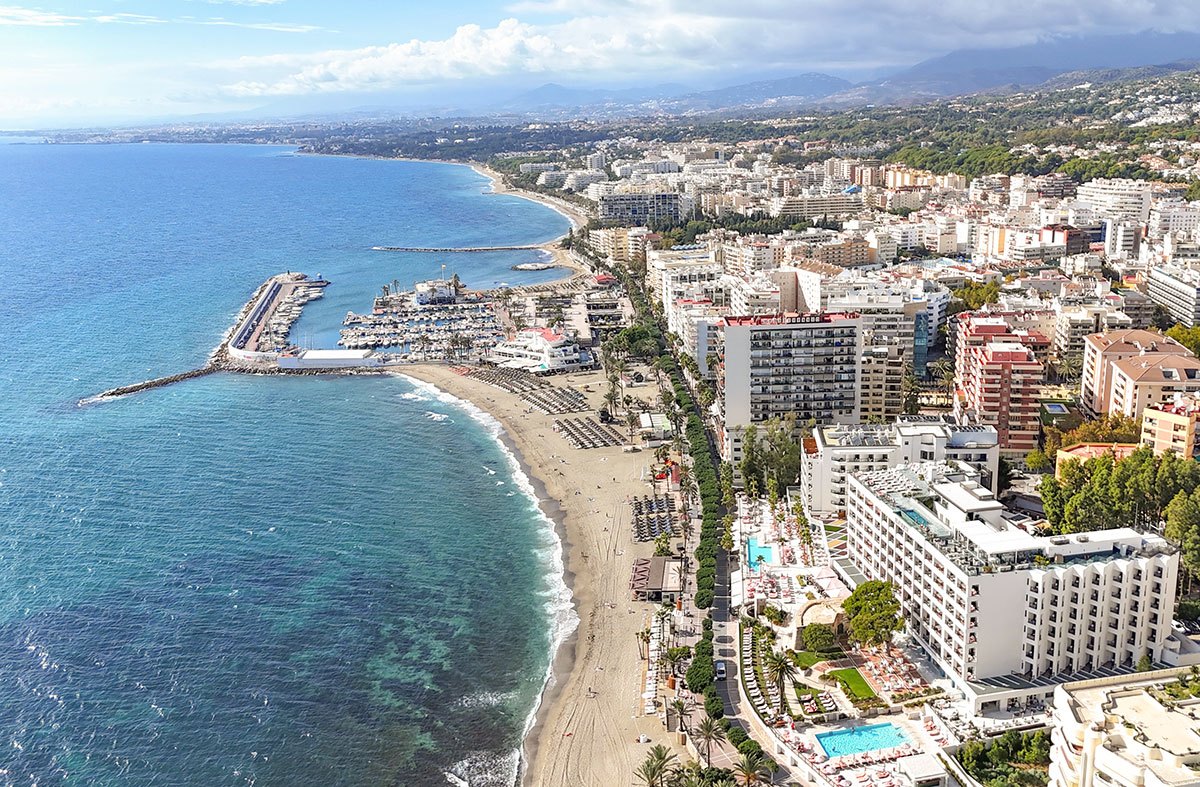
Marbella's Neighbourhoods
Each with its own character. From beachfront to hillside, here are the areas we recommend.
We currently have 114 properties for sale in Marbella. Browse listings →
Not sure which area suits you?
Find your perfect area
Take our Zone Finder quiz and we will match you to one of the 65+ zones we cover.
Take the Zone Finder quiz → English
 Spanish
 Dutch
 French
 Polish
 Swedish
 German