
 EN
EN ES
ES NL
NL PL
PL SV
SV DE
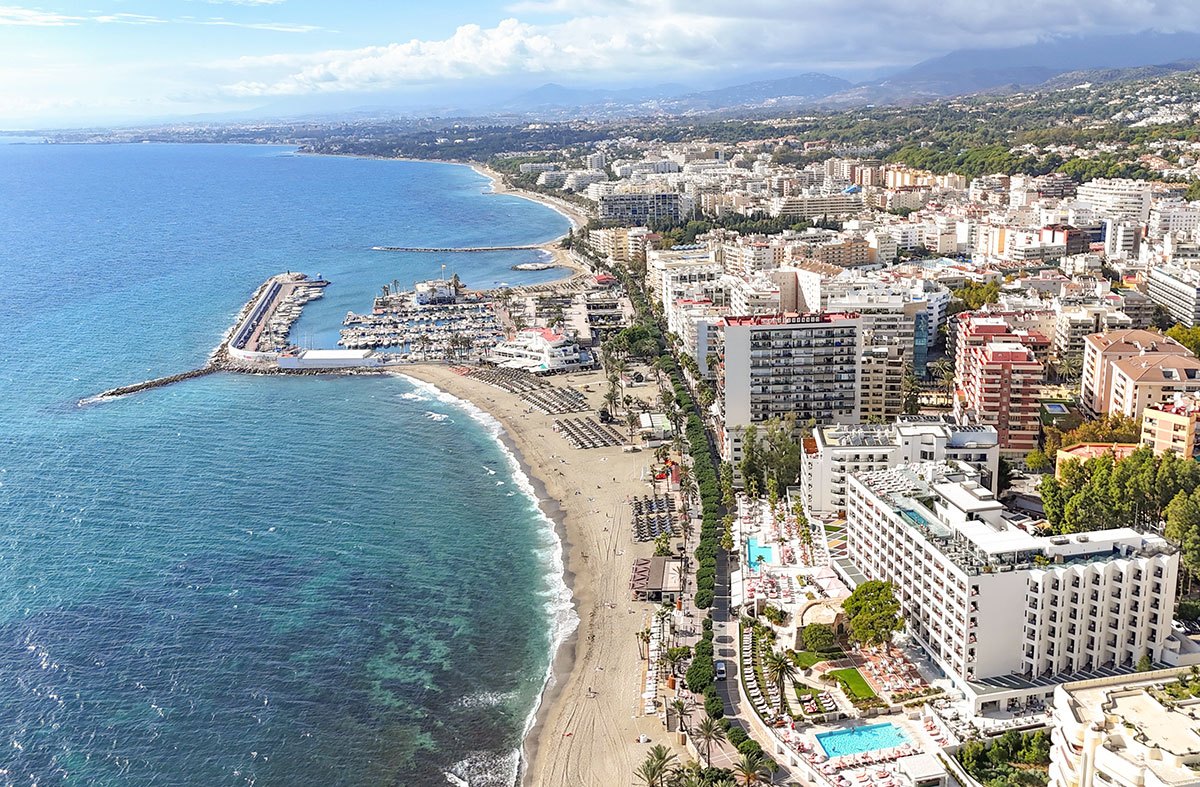
DEMarbella est la municipalité phare de la Costa del Sol, s'étendant sur 27 kilomètres le long de la côte méditerranéenne entre les montagnes Sierra Blanca et la mer. Sa population a atteint 173 420 résidents enregistrés au rôle municipal (padrón) en janvier 2026, contre 156 295 il y a seulement trois ans — une augmentation de plus de 17 000 personnes en trois ans, avec plus de neuf nouveaux arrivants sur dix en provenance de l'extérieur de l'Espagne. Environ 36 % des résidents ont une nationalité non espagnole à travers 155 pays ; le Maroc est la plus grande nationalité étrangère (plus de 6 100 résidents), suivie de grandes communautés britanniques, colombiennes et d'Europe du Nord.
Six sous-marchés distincts composent le paysage résidentiel : les quartiers balnéaires occidentaux de Guadalmina et San Pedro de Alcántara, les collines riches en golf de Nueva Andalucía, le prestigieux Golden Mile corridor et l'historique vieille ville, et la longue bande côtière orientale de Los Monteros to Cabopino.
Comment Marbella est devenue Marbella
La transformation de Marbella d'un village de pêcheurs en synonyme international du luxe remonte à 1947, quand l'aristocrate espagnol-allemand le Prince Alfonso von Hohenlohe a acheté des terres ici. En 1954, il ouvre le Marbella Club comme une retraite privée pour les amis et leur cercle — il a attiré Deborah Kerr, Ava Gardner, Frank Sinatra et un nombre croissant de royauté européenne et d'industriels, et a effectivement inventé la réputation jet-set de la ville. Une décennie plus tard, le promoteur José Banús a capitalisé sur cet élan : la construction de Puerto Banús a commencé en 1965 sous les architectes Antonio Lamela et Noldi Schreck, délibérément conçu comme un village andalou à faible hauteur plutôt que les blocs de haute hauteur initialement proposés, et la marina a ouvert en 1970. Puerto Banús abrite maintenant environ 915 postes d'amarrage pour les embarcations jusqu'à 50 m, parmi les marinas les plus chères d'Europe pour l'amarrage.
Sur le flanc occidental, Guadalmina Baja et Guadalmina Alta proposent des parcelles viabilisées avec villas à côté des terrains de golf de Guadalmina. San Pedro de Alcántara est une vraie ville espagnole animée avec un boulevard redessiné, un marché hebdomadaire et une vie locale tout au long de l'année. À l'intérieur des terres depuis Puerto Banús, la Nueva Andalucía Golf Valley se regroupe autour de Las Brisas, Aloha et Los Naranjos clubs de golf, en faisant l'une des zones de golf les plus denses d'Europe.
La Golden Mile relie Puerto Banús à la vieille ville de Marbella, bordée du Marbella Club Hotel, Puente Romano Beach Resort et les clubs de plage de référence. Au-dessus, Sierra Blanca et Nagüeles proposent des domaines clôturés en flanc de colline avec vue panoramique sur la mer. Le Casco Antiguo (vieille ville) s'articule autour de la Plaza de los Naranjos, aménagée en 1485 après que Marbella soit passée pacifiquement aux Monarques catholiques ; son hôtel de ville de style Renaissance, construit en 1568, porte toujours des plaques en vieux castillan commémorant la conquête de 1485, et l'Ermita de Santiago adjacente est le plus ancien bâtiment religieux de la ville. Les ruelles blanchies à la chaux, les bars à tapas et une scène galéristique croissante remplissent les rues autour de lui.
À l'est du centre, le littoral traverse Río Real, Elviria, Santa Clara, El Rosario et Las Chapas, chacun offrant un mélange de villas en bord de mer, de résidences sécurisées et d'écoles internationales telles que Swans et l'English International College. Cabopino ferme la commune avec une petite marina et des dunes naturelles protégées. À l'intérieur des terres, Palo Alto est un éco-projet de charme près du village d'Ojén.
Marbella quartier par quartier
Marbella s'étend sur 27 km de côte et compte au moins six marchés portant un seul nom. Chaque quartier ci-dessous dispose de son propre guide avec les distances, les écoles, ce qui se vend et ce que nous dirions à un client avant une visite.
La Mille d'Or et la colline au-dessus
La Golden Mile s'étend du vieux centre à Puerto Banús, avec Puente Romano en bord de mer et Lomas de Marbella Club, Nagüeles, Cascada de Camoján et Sierra Blanca montant les pentes de La Concha derrière. C'est le terrain le plus cher du sud de l'Espagne et la seule partie de Marbella où il n'y a simplement plus de terrain disponible.
Le centre
Marbella Centro est le vieux centre autour de la Plaza de los Naranjos et la promenade côtière : l'option piétonne, la meilleure cuisine de la côte et le moins de places de parking.
Puerto Banús et la Vallée du Golf
Puerto Banús est la marina, les appartements et le bruit en août. Derrière, Nueva Andalucía se trouve la Vallée du Golf, où se font la plupart de nos ventes de villas : Las Brisas, Aloha, Los Naranjos et, à l'extrémité orientale à côté du golf Los Naranjos, les grandes parcelles de Haza del Conde.
Ouest : San Pedro et Guadalmina
San Pedro de Alcántara est une véritable ville dans la municipalité, avec un boulevard, un marché et les écoles que choisissent les familles. Nueva Alcántara est son quartier familial entre la ville et la plage, Linda Vista les rues de villas côtières plates à son extrémité occidentale, et Guadalmina Baja et Guadalmina Alta les parcelles de villas matures de part et d'autre des terrains de golf Guadalmina à la frontière avec Estepona.
Est : de Río Real à Cabopino
Marbella Est est un marché différent de celui de la Mille d'Or : plus tranquille, plus vert, avec les clubs de plage que fréquentent les habitants. Il s'étend à travers Río Real, Los Monteros, Santa Clara, El Rosario, Elviria et Las Chapas to Cabopino, le petit port et les dunes d'Artola à la limite municipale. À l'intérieur des terres, Palo Alto est le développement boutique en colline près d'Ojén.
Qu'est-ce qui a changé à Marbella en 2026
Les actualités de Marbella en 2026 ont porté sur les marques et l'urbanisme. Le 20 octobre, les promoteurs de la parcelle Las Dunas à Marbella Est ont signé avec Marriott pour un hôtel St. Regis avec 169 chambres et 151 résidences, un projet de 500 millions d'euros avec l'hôtel prévu en 2031. À l'entrée orientale de la ville, resort Four Seasons a changé de mains au printemps, quand Immobel et Fort Partners ont acheté 90 pour cent du terrain à Ricardo Arranz, et à côté Oakmond a signé un prêt de 145 millions d'euros en septembre pour transformer l'ancien Incosol en resort de longévité avec 140 chambres, 28 résidences et une clinique. Sur la Mille d'Or, Armani Residences a son permis de construire à Nagüeles, et l'expansion de la famille royale saoudienne à Al Riyadh a obtenu son approbation locale en juin.
Le conseil a approuvé un quartier de 156 logements à La Cañada après six ans de traitement, et la Junta a confirmé une expansion de 200 millions d'euros de la marina La Bajadilla. Sur la route, l'État a fermé plusieurs sorties de l'A-7 à Elviria et Las Chapas le 22 septembre, ce qui a changé la façon dont des milliers de résidents rentraient chez eux, et Enaire a choisi le corridor Málaga-Marbella pour les essais de taxis aériens en 2028. Pour les chiffres derrière tout cela, notre perspectives du marché mi-année les contiennent, et l’histoire de la Golden Mile explique comment la ville en est arrivée là.
Dîner à Marbella
La scène des restaurants de Marbella s'étend de la gastronomie fine étoilée Michelin au glamour du beach-club. Skina, dans la vieille ville, détient deux étoiles Michelin. La bande des restaurants de Puente Romano comprend Nobu Marbella, COYA, LEÑA de Dani García et GAIA. Le long de la côte, les beach clubs comme La Sala by the Sea à Puerto Banús et Nikki Beach à Las Chapas ancrèrent la scène sociale diurne de Marbella.
Informations pratiques
- Population : 173 420 (janvier 2026, registre municipal), en hausse de 156 295 en 2023 ; environ 36 % de ressortissants étrangers à travers 155 nationalités
- Aéroport Málaga-Costa del Sol (AGP) : 45 à 60 km à l'ouest, grosso modo 35 à 50 minutes en voiture
- Hôpital : L'Hospital Costa del Sol (public) et Quirónsalud Marbella (privé) desservent la commune
- Marina : Puerto Banús, environ 915 postes d'amarrage pour bateaux jusqu'à 50m, ouvert en 1970
- L'autoroute AP-7 et la route côtière A-7 relient tous les sous-marchés
- Température moyenne toute l'année est de 18°C, avec plus de 300 jours d'ensoleillement
- Prix des propriétés (2026) : Prix moyen demandé autour de €6 075/m² (les données Tinsa/Crinoa placent les prix de vente vérifiés plus proche de €3 421/m²), variant d'environ €5 450/m² à San Pedro de Alcántara à près de €7 000/m² sur la Golden Mile ; points d'entrée à partir d'environ €250 000 jusqu'à bien au-delà de €20 millions pour les méga-villas en versant
Acheter une propriété à Marbella
Les reventes paient 7 pour cent de taxe de transfert aujourd'hui et 6,75 pour cent à partir de 2027; les constructions neuves paient 10 pour cent de TVA et 1,2 pour cent de droit de timbre. Ce qui est spécifique à Marbella, c'est l'urbanisme : la ville fonctionne toujours selon son plan général de 1986 avec des corrections au cas par cas, car le plan de 2010 a été annulé en 2015, donc l'historique des licences d'une villa compte plus ici que nulle part ailleurs sur la côte. Nos quatre contrôles de diligence raisonnable le couvrent, et le processus d'achat prend quatre à huit semaines une fois la paperasserie en ordre. Tout ce que nous avons à vendre dans la municipalité, avec la gamme de prix en direct et une section de marché écrite, se trouve sur notre page propriétés Marbella.
Nouveaux programmes à Marbella
Le marché du neuf de Marbella comprend des appartements sur la Golden Mile, des villas à Nueva Andalucía et des complexes en bord de mer. Voir tous nouveaux programmes à vendre à Marbella.
Questions fréquentes
Quelle est la taille de Marbella et combien de personnes y vivent ?
Le registre municipal de Marbella comptait 173 420 résidents en janvier 2026, en hausse par rapport à 156 295 en 2023 – un gain de plus de 17 000 en trois ans, impulsé massivement par la migration internationale. La municipalité s'étend sur 27 km le long de la côte.
Quelle est la différence entre Puerto Banús et la Golden Mile ?
Puerto Banús est le quartier marina et divertissement construit par José Banús à partir de 1965, ouvert en 1970, avec environ 915 postes d'amarrage et une concentration de boutiques de luxe et de vie nocturne. La Golden Mile est le couloir résidentiel et hôtelier de 6 km reliant Puerto Banús à la vieille ville de Marbella, accueillant le Marbella Club, le Puente Romano et une succession de propriétés en bord de mer.
Comment Marbella est-elle devenue célèbre pour le luxe ?
Cela remonte à 1954, quand le Prince Alfonso von Hohenlohe a ouvert le Marbella Club comme retraite privée qui a attiré la royauté européenne et les stars hollywoodiennes. Le développement Puerto Banús de José Banús, ouvert en 1970, a consolidé cette réputation avec une marina conçue pour rivaliser avec Saint-Tropez.
Quel est le coût des propriétés à Marbella ?
Les prix moyens demandés étaient autour de €6 075/m² en janvier 2026, bien que les prix de vente vérifiés réels soient plus bas, plus proches de €3 421/m² selon les données Tinsa. Les prix varient considérablement selon les zones, d'environ €5 450/m² à San Pedro de Alcántara jusqu'à près de €7 000/m² sur la Golden Mile.
Marbella est-elle une vraie ville ou juste une station balnéaire ?
Les deux. La vieille ville (Casco Antiguo) fonctionne comme un véritable centre-ville andalou autour de la Plaza de los Naranjos, tandis que des zones comme San Pedro de Alcántara ont leur propre caractère de ville locale fonctionnelle. À côté de cela se trouve l'une des économies de station balnéaire les plus établies internationalement en Europe – clubs de plage, stations de golf et hôtels cinq étoiles concentrés le long de la côte et dans la Golf Valley.
Quel système de santé est disponible à Marbella ?
L'Hospital Costa del Sol est l'hôpital public desservant la municipalité ; Quirónsalud Marbella est le principal hôpital privé. Les deux sont largement utilisés par la population résidente internationale.
Quels sont les secteurs de Marbella ?
Six groupes : la Mille d'Or et la colline au-dessus (Nagüeles, Sierra Blanca, Cascada de Camoján, Lomas de Marbella Club), le vieux centre-ville, Puerto Banús et la vallée du golf Nueva Andalucía (Las Brisas, Aloha, Los Naranjos, Haza del Conde), San Pedro de Alcántara avec Nueva Alcántara, Linda Vista et les deux Guadalmina, Marbella Est de Río Real à travers Los Monteros, Santa Clara, El Rosario, Elviria et Las Chapas jusqu'à Cabopino, et Palo Alto à l'intérieur des terres. Chacun dispose de son propre guide, lié dans la section quartier par quartier ci-dessus.
San Pedro de Alcántara fait-il partie de Marbella ?
Oui. San Pedro est un district de la municipalité de Marbella, à 10 km à l'ouest du centre, avec son propre bureau municipal, son marché et ses écoles. Les prix y avoisinent en moyenne 5 450 euros le mètre carré contre près de 7 000 sur la Mille d'Or, c'est pourquoi les familles qui recherchent une véritable ville plutôt qu'une station balnéaire finissent par s'installer à San Pedro, Nueva Alcántara ou Linda Vista.
Quel est le meilleur quartier où vivre à Marbella ?
Cela dépend de ce que vous achetez. Les familles qui ont besoin d'écoles et d'une ville : San Pedro, Guadalmina ou Elviria. Golf : Nueva Andalucía. Proximité des restaurants : le vieux centre ou le côté plage de la Mille d'Or. Intimité et vues : Sierra Blanca, Cascada de Camoján ou Nagüeles. Plages tranquilles et forêts de pins : Marbella Est. Nous le disons à chaque client : choisissez d'abord le quartier, la maison ensuite.
Puis-je acheter un terrain à Marbella ?
Oui, bien que les terrains soient rares et que la plupart des bons se trouvent dans la Golf Valley, sur le flanc de la Golden Mile ou à Benahavís à côté. Les questions à régler avant de verser un acompte sont le volume constructible selon le plan actuel, si l'infrastructure de l'urbanisation est complète et reçue par la mairie, et le calendrier des licences, qui à Marbella est lent. Nous énumérons les terrains quand nous les avons sur notre page de propriété Marbella.
À quelle distance Marbella se trouve-t-elle de l'aéroport de Málaga ?
Entre 45 et 60 km selon le district, 35 à 50 minutes en voiture par l'autoroute à péage AP-7. Marbella Est est la plus proche, San Pedro et Guadalmina les plus éloignées. L'aéroport de Gibraltar se trouve à environ 80 km et un peu plus d'une heure.
Marbella's Neighbourhoods
Chacun avec son propre caractère. Du bord de mer aux hauteurs, voici les secteurs que nous recommandons.
Nous avons actuellement 114 propriétés à vendre à Marbella. Voir les annonces →
Vous ne savez pas quel secteur vous convient ?
Trouvez votre zone parfaite
Répondez à notre quiz Zone Finder et nous vous correspondrons à l'une des 65 zones ou plus que nous couvrons.
Répondez au quiz Zone Finder → English
 Spanish
 Dutch
Dutch French
 Polish
 Swedish
 German